


Why Are People Afraid of Dogs? – Insights into Canine Behaviour & Human Fear

🐾 Why Are People Afraid of Dogs?
The Ancient Bond and the Modern Fear
Dogs have lived alongside humans for thousands of years.
They have been hunters, guardians, companions, and healers.
Yet, despite this ancient partnership, a surprising number of people are deeply afraid of them.
This fear is not trivial.
It is often visceral — the racing heart, the tightening chest, the sudden urge to cross the road when a dog approaches.
But why do dogs, who for many of us embody loyalty and unconditional love, inspire such fear in others?
The answer lies in both human psychology and canine behaviour.
1. Early Experiences Shape Lifelong Fears
For many, the fear of dogs stems from childhood experiences.
A sudden bark, a rough chase, or even a nip can leave lasting impressions on a child’s psyche.
The mind records not the dog’s intent, but the shock of vulnerability.
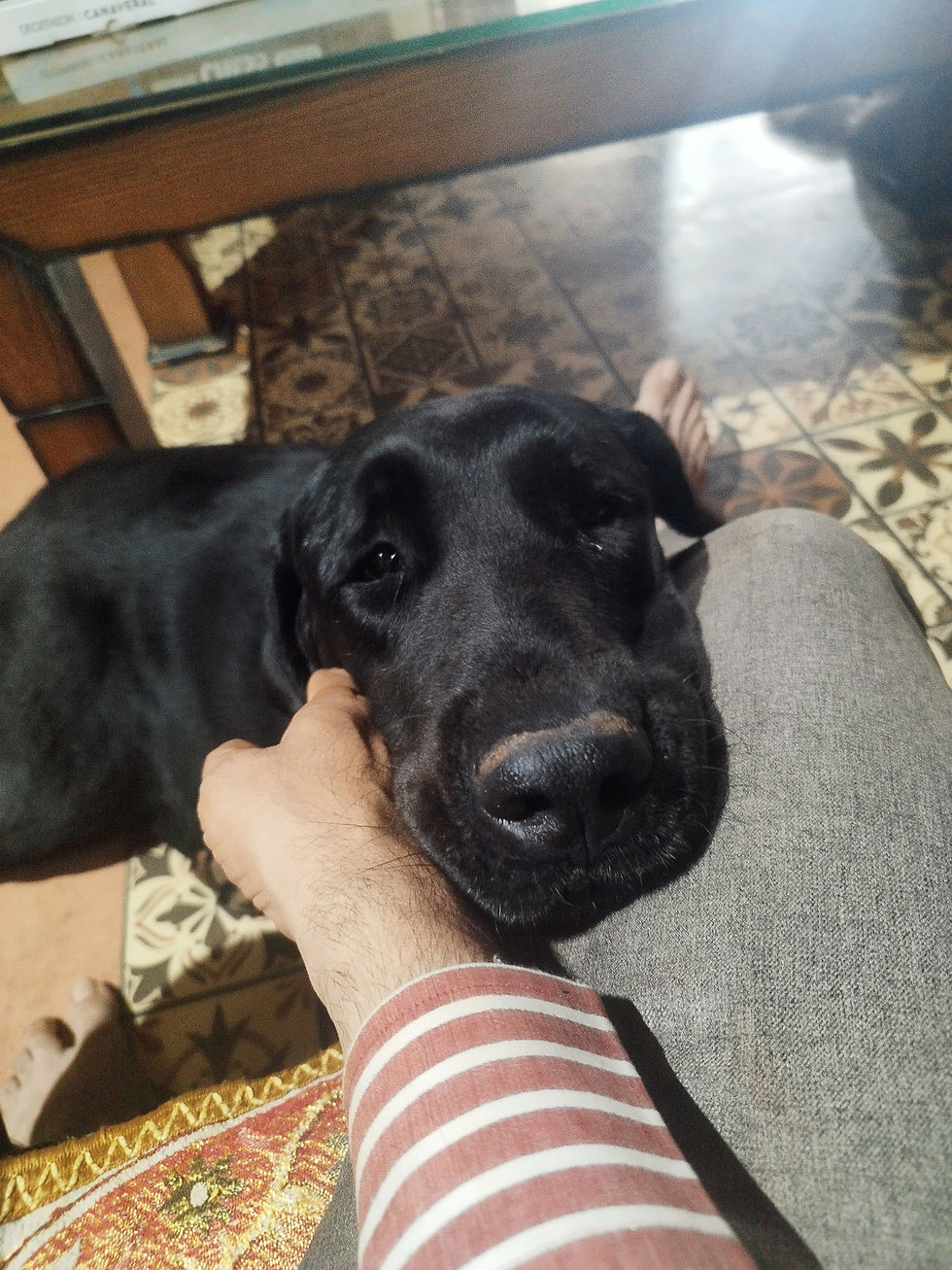
In contrast, a child who grows up with a gentle dog like Sita at Ananda Neelam learns something else: that dogs can be protectors, listeners, and even silent healers.
2. The Unpredictability Factor
Humans fear what they cannot predict.
Dogs, with their sudden movements, loud barks, or sheer physical presence, often appear unpredictable to those unfamiliar with their body language.
Yet, for those who take the time to learn, every flick of a tail, every tilt of the head, every growl or whimper is part of a language.
Dogs are not unpredictable — they are simply speaking a dialect most humans have forgotten to understand.
3. Projection of Human Emotions
Sometimes, our fear of dogs is not about the animal itself but about what they represent.
Their sharp teeth remind us of primal danger.
Their unwavering gaze mirrors truths we hide from ourselves.
Their loyalty contrasts with the fractured trust in human relationships.
To some, this reflection feels overwhelming, and fear becomes the mask for discomfort.
4. Cultural Beliefs and Conditioning
In many societies, dogs are revered as protectors.
In others, they are seen as unclean, dangerous, or even carriers of disease.
Such cultural narratives shape personal fears and reactions.
Where one child hears, “Dogs are family,” another hears, “Stay away, they bite.”
5. The Path Beyond Fear: From Distance to Respect
Dr. Chari often reminds villagers in Ponmanipudi: “Fear is the shadow of ignorance. Respect is the light of understanding.”
A person who fears dogs does not need to become a dog-lover overnight.
Instead, they can begin with simple steps:
Observe dogs from a safe distance.
Learn their signals — a wagging tail, a low growl, a raised paw.
Witness how dogs mirror human moods — Sita waiting quietly when Chari leaves, Mylo bounding with joy when he returns.
Over time, fear transforms into respect.
And respect, not blind affection, is the foundation of a healthy human–dog relationship.
Final Reflection
Dogs are not merely animals; they are mirrors of our own emotional landscapes.
For those who fear them, perhaps the real journey lies not in taming the dog, but in taming the fear within.
Because once we see dogs not as threats, but as fellow beings with emotions, histories, and instincts — the fear dissolves into something more profound: compassion.
And compassion, like trust, is a bridge that no bark can break. 🐶


Comments